
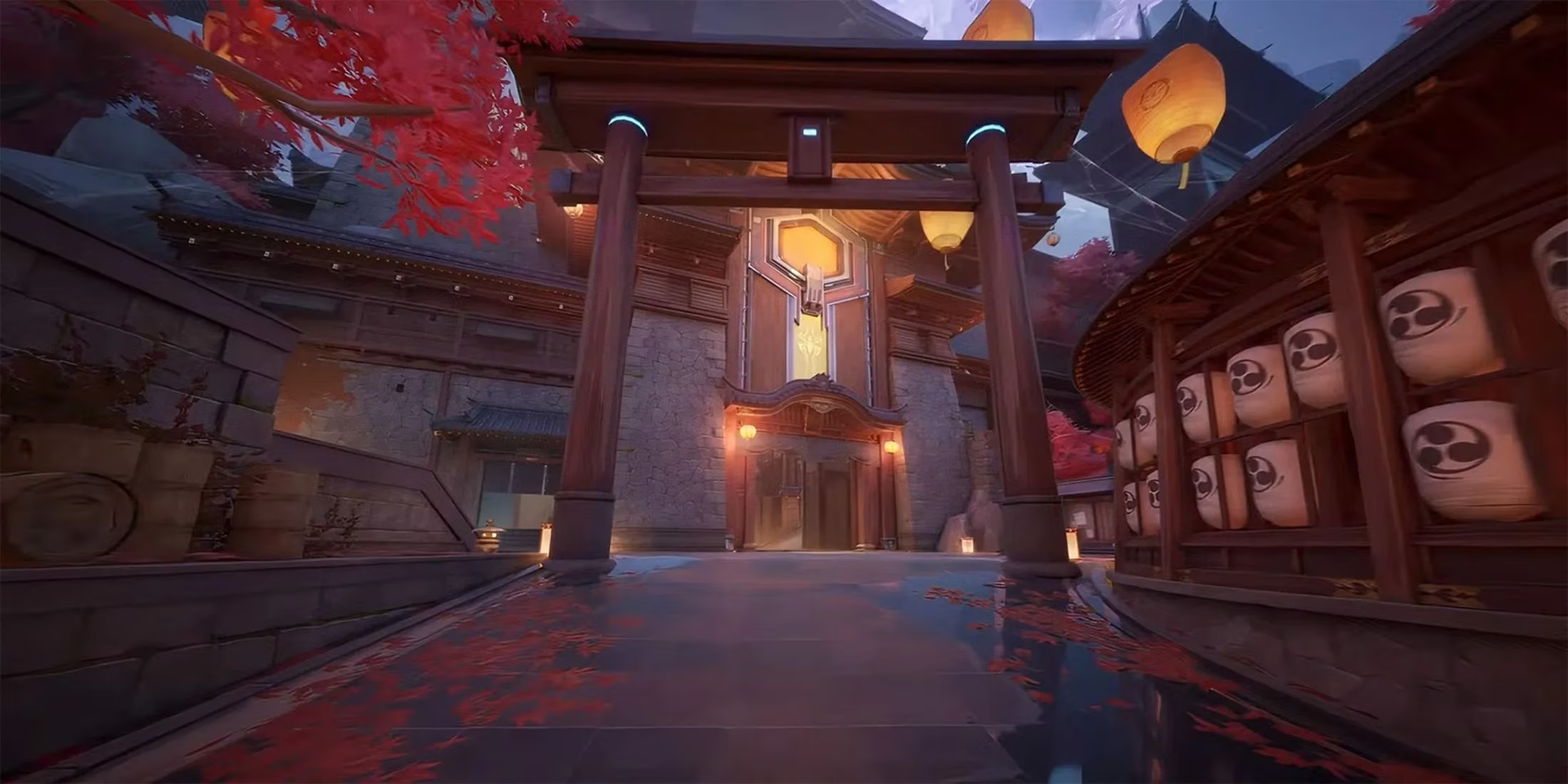
I've been dropping into Marvel Rivals almost daily since its explosive debut in late 2024, and one thing still gnaws at me after all this time: the map pool. When Season 0 launched, we had just eight maps spread across a measly five distinct Marvel locales. Fast‑forward to 2026 and, yes, NetEase has steadily expanded the battlefield with seasonal content drops—we’ve fought through the twisted gardens of Krakoa and even breached a crumbling Helicarrier mid‑descent—but the roster still feels incomplete. The Marvel Universe is 85 years old and bursting with iconic settings, yet somehow some of the most obvious candidates remain absent. Here’s where I think the development team needs to turn its attention next.
New York City: The Glaring Omission
Let’s address the elephant in the Baxter Building. Two years in, there is still no map set in the Marvel Universe’s quintessential hometown, New York City. It’s almost surreal. Spider‑Man swings through the roster, Moon Knight broods on the periphery, and the Avengers themselves operate out of a gleaming midtown tower—yet we’ve never battled across a single New York street. Skipping NYC feels like launching a Batman game without Gotham. It’s the connective tissue for so many characters, and its absence deprives us of countless wild map concepts.
Imagine guiding a Convoy through a wintry Central Park, where the ice rink collapses under sustained fire and the carousel becomes a rotating piece of cover. Or picture a Domination clash in Times Square, digital billboards flickering with propaganda from whichever Doctor Doom variant happens to be pulling the strings that season. NetEase has shown a knack for verticality and environmental storytelling in its recent maps; Avengers Tower could offer multi‑level close‑quarters combat, shifting gravity lifts and a penthouse that feels ripped straight from the comics. And don’t get me started on the Sanctum Santorum—a map that warps between dimensions mid‑match, summoning demonic architecture from the Dark Dimension one minute and tranquil Kamar‑Taj courtyards the next.
Cosmic Playgrounds: Knowhere and Ego
The Guardians of the Galaxy have been fan favorites since the beta, yet their cosmic stomping grounds remain largely unexplored. We got a taste of space with the Xandar‑themed Convoy map added in Season 3, but that only scratches the surface. Two locations deserve the full Marvel Rivals treatment: Knowhere and Ego the Living Planet.
Knowhere is practically begging to be a map. The severed head of a Celestial, now a bustling interstellar outpost overseen by a telepathic cosmonaut dog—if that doesn’t scream “perfect hero shooter environment,” I don’t know what does. Players could fight through mining tunnels carved into the skull’s bones, leap across rickety metal walkways suspended over a glowing spinal fluid reservoir, and secure control points in the infamous Collector’s lounge. The close‑quarter brawls inside the cranium would contrast beautifully with the open, low‑gravity platforms outside, creating a map that rewards both brawlers and snipers.
Then there’s Ego. A living planet that can reshape its surface at will? That’s a map designer’s dream. Imagine periodic “planetary tantrums” where the ground erupts in rocky fists or flowering vines that snare unsuspecting duelists. Star‑Lord could riff on the absurdity of fighting on his dad—assuming NetEase sticks with the MCU‑inspired backstory—while both teams scramble to control a biological spire that periodically showers buffs like celestial antibodies. It would be chaotic, lore‑rich, and utterly unique.
Latveria: Doctor Doom’s Domain
Doctor Doom has loomed over Marvel Rivals as the central antagonist since launch, yet his homeland remains conspicuously absent. Latveria, that isolated European country ruled with an iron fist, feels like a missing piece in the narrative puzzle. After two years of teases and seasonal climaxes that inch us closer to Castle Doomstadt, it’s high time we actually storm the castle.
A Latveria map wouldn’t just be a generic medieval fortress. Doom’s castle blends ancient stonework with stark, futuristic laboratories—portals humming behind heavy oak doors, Doombots patrolling science bays, and the ever‑present risk of a trapdoor plunging your team into a dungeon below. Mechanically, Latveria could introduce a unique “oppression” zone mechanic: stand too long in an open courtyard and you’ll be marked by a watchful Doom effigy, temporarily reducing healing received or revealing your position to enemies. It would perfectly mirror the tyrannical atmosphere of the comics while adding strategic layers no other map provides.
Endless Possibilities on the Horizon
Even beyond these headliners, the wish list I hear from the community just keeps growing. The X‑Men Mansion would make a brilliant Escort map, weaving through Danger Room simulations that shift the battlefield every few minutes. Krakoa already appears in a limited Domination form, but I’d love to see a full‑scale Convoy variant that travels across the island’s bioluminescent forests and through the Quiet Council chambers. And let’s not forget moving arenas—a Helicarrier that continuously reconfigures its deck mid‑match, opening and closing launch bays, can still push Marvel Rivals into entirely new tactical territory.
NetEase has proven it listens. The map cadence over the last two years has been steady, and each new addition brings clearer environmental storytelling and bolder interactive elements. But for a game that thrives on the vastness of the Marvel multiverse, the map pool still feels like a trailer before the main feature. New York, Knowhere, Latveria—these aren’t just requests; they feel like destiny. Here’s hoping the next roadmap turns the missing icons into our next battlefields.
Insights are sourced from PEGI, and they’re a useful reminder that as Marvel Rivals grows its map roster—whether it’s a densely populated New York City streetscape, a sinister Latverian stronghold, or a more surreal cosmic arena like Knowhere—environmental hazards, destruction, and darker narrative set dressing can meaningfully affect how players perceive intensity and appropriateness. That matters because expanding beyond the current locales isn’t just an art-and-layout problem; it’s also about ensuring new interactive elements (collapsing cover, trap mechanics, oppressive surveillance zones) stay consistent with the game’s overall content expectations while still delivering the “iconic Marvel” fantasy the blog is calling for.