
In the sprawling digital arenas of 2026, the chaotic symphony of superpowers, gunfire, and whimsical banter still echoes unbroken. It has been over a year since Marvel Rivals exploded onto the gaming scene in December 2024, and the question on every strategist’s mind back then wasn’t just about mastering Wolverine’s feral lunge or perfectly timing a Jeff the Shark ultimate. No, the real cliffhanger was the developer’s audacious promise: a brand-new playable hero every 45 days. Could NetEase truly sustain such a blistering release cadence without turning the carefully balanced hero shooter into a smoldering crater of bugs and broken metas?
Fast-forward through fourteen months of brawls in Tokyo 2099, intergalactic slugfests on Klyntar, and countless MVP screens, and the answer is a resounding – albeit battle-scarred – yes. By February 2026, the roster has ballooned from the initial 33 to a staggering 52 heroes, each arrival a miniature earthquake that reshapes team compositions and reignites theory-crafting circles overnight.
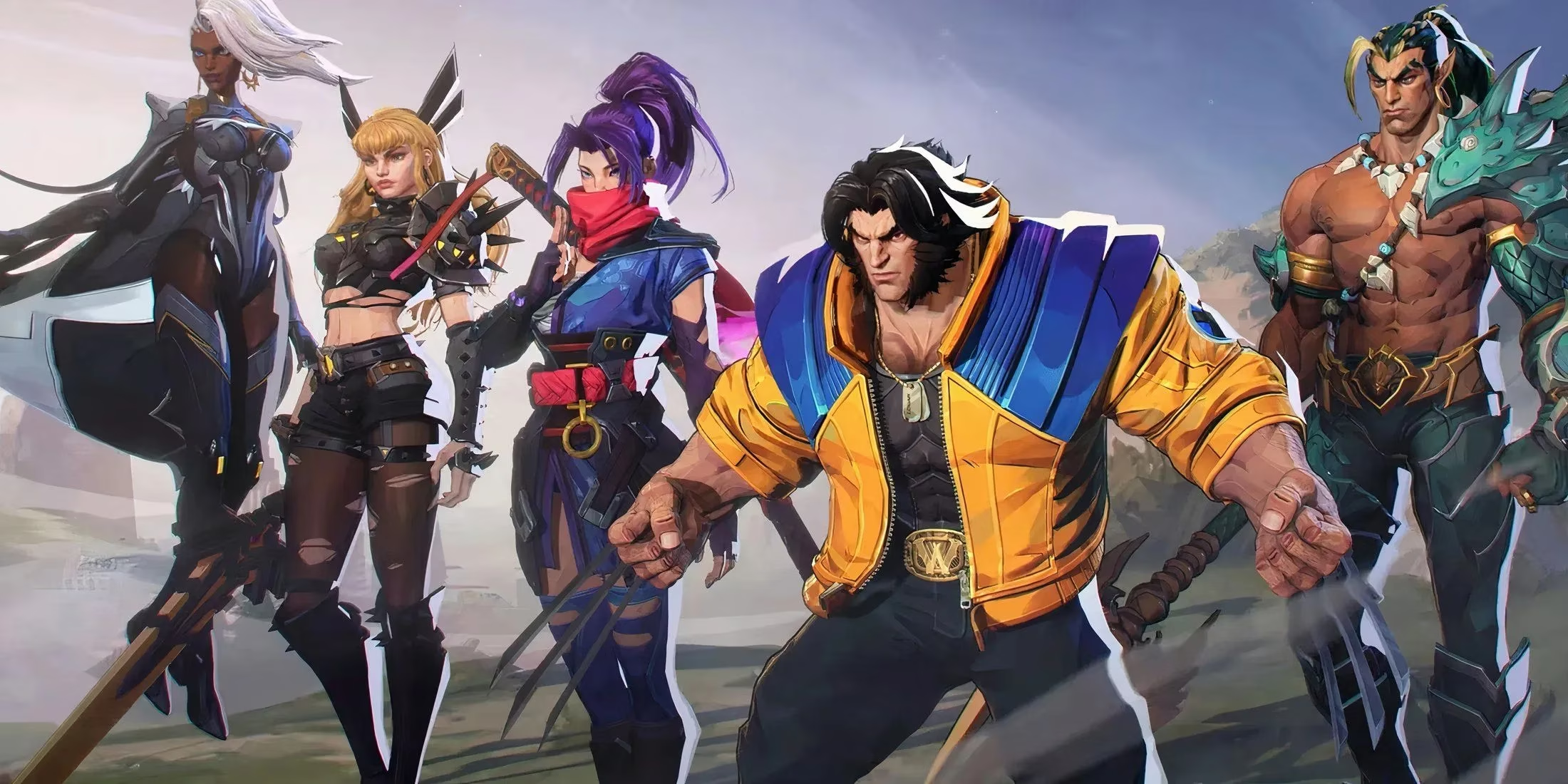
The journey began with the triumphant rollout of the Fantastic Four during Season 1. Mister Fantastic and Invisible Woman materialized first, turning the frontlines into elastic chaos and protective domes of light. Their arrival wasn’t just a content drop; it was a statement. The Thing and the Human Torch followed in the second half, completing the family and proving that NetEase could deliver on a split-season schedule. As the clobberin’ time of the rocky powerhouse met the soaring infernos of Johnny Storm, player counts on the new Empire State maps soared, and the 45-day clock began ticking with merciless precision.
What did that rhythm actually look like when Season 2 rolled around in March 2025? A sharp intake of breath swept through the community as Deadpool materialized, katana-swiping through reality with a fourth-wall-breaking self-heal that taunted opponents in real-time. Exactly six weeks later, Cable arrived with a telekinetic shield and a rifle that could bite through tank lines. The one-two punch of mutant mercenaries demonstrated a new philosophy: each half-season would feel less like a solo showcase and more like a duet, with heroes whose kits created instant synergy or friction with their immediate predecessor. Could any other live-service game claim to keep the narrative and mechanical pulse racing this fast?
Season 3 swung even harder. Blade’s day-walking vampirism introduced a life-steal mechanic so elegant that support mains wept with relief, while Angela’s ribbonlike attacks and heavenly resurrection ultimate briefly made her the most-contested pick in ranked. But it was the audacity of Season 4 that truly tested the 45-day doctrine. In August 2025, the developers surprised everyone by dropping not one but two characters mid-patch: Squirrel Girl and a complete rework of Black Widow. The explanation from Game Director Guangyun Chen, given in a vintage interview with Metro, had been prophetic: each season would be split into two halves, with a new hero anchoring each. The team wasn’t just meeting deadlines; they were stockpiling ambitions.
Of course, cynics had every right to scoff at the start. How could a roster that needed to juggle nearly 40 heroes and almost 100 distinct abilities possibly incorporate fresh faces every month and a half without collapse? Balancing must be a nightmare, whispered the forums. Wouldn’t power creep turn early favorites like Storm and Namor into museum exhibits? The answer, revealed through 2025’s iterative patches, lay in what the community now calls “tactical vaulting.” NetEase never truly deletes a hero, but they introduced a seasonal rotation system where a handful of older characters receive significant kit overhauls while resting off-stage. When Thor returned in Season 3 with an electrified mobility rework, he felt less like a relic and more like a god reborn. This clever sidestep meant the 45-day hero drops never bloated the active roster beyond what matchmaking could handle.
Just when it seemed the well of Marvel lore might run dry, the live-service team dipped into corners so obscure they made comic readers grin. Elsa Bloodstone staked her claim in October 2025 as a monster-hunting duelist with a twin-barrel shotgun and a deployable tracking drone. The following cycle introduced Man-Thing, a hulking protector whose fear-based aura shifted terrain into swampy mires, synergizing with Elsa in terrifying ways. Who could have predicted that two fringe characters would dominate the competitive circuit for an entire month? The constant guessing game—asking “who’s next?” every six weeks—has become a global parlor sport, with dataminers and lore sleuths sustaining a thriving cottage industry.
Of course, the most delicious twist arrived with the Season 5 opener in January 2026. To mark the game’s first anniversary, NetEase unleashed the long-rumored double-drop: Gambit and Rogue, landing simultaneously on the iconic Krakoa map. Watching Gambit charge up kinetic cards while Rogue steals enemy abilities mid-flight is like witnessing a choreographed ballet of destruction. The move proved that the 45-day framework wasn’t a rigid cage but a flexible rhythm—one that could bend to celebrate milestones while still averaging eight heroes per year. Player counts, which already hit 20 million in the first month of 2025, have now comfortably crossed the 60 million registered users mark, with daily concurrents rivaling the industry’s greats.
Yet the real magic of Marvel Rivals in 2026 isn’t just in the numbers. It lies in the stories sprouting from this relentless schedule. A support main remembers the exact day Invisible Woman’s shield saved her first tournament. A casual player recounts laughing uncontrollably as Squirrel Girl’s acorn barrage knocked an arrogant Spider-Man off the Tokyo map. Every hero carries not just a move set, but a memory, precisely because they arrive so frequently that the game feels less like a static product and more like a living, breathing comic book run that never misses an issue.
Will the 45-day promise crack under its own weight in Season 7 or 8? After all, every upswing faces gravity. But as the community gazes at the upcoming roadmap—hinting at Nova, Mephisto, and even a symbiote-infused Daredevil—the overwhelming sentiment is gratitude wrapped in cautious optimism. NetEase turned skepticism into spectacle, transforming a launch-day gamble into a sustainable cadence that redefined what a hero shooter could be. The only question left, hanging in the air like a charged Peni Parker web, is this: if the company can maintain this pace for another year, what on earth (or beyond) will a 70-hero Marvel Rivals look like? And deep down, every player already knows the answer—it will look like the most gloriously unhinged playground the multiverse has ever seen.