
I have a confession: when I daydream about Marvel power rankings, my brain usually reaches for the usual suspects—Hulk, Thor, Sentry, Juggernaut, maybe Superman if we are crossing fictional fences. Then I reread Ultimate X-Men/Ultimate Fantastic Four Annual, and my entire mental bracket flips like a chessboard during an earthquake. Kitty Pryde—yes, the X-Men's resident phase-through-walls genius—can, in the right version, hit with the force of the Hulk. Not metaphorically. Not merely for a mutant. Literally: her super-dense fists land like verdant gamma thunder.
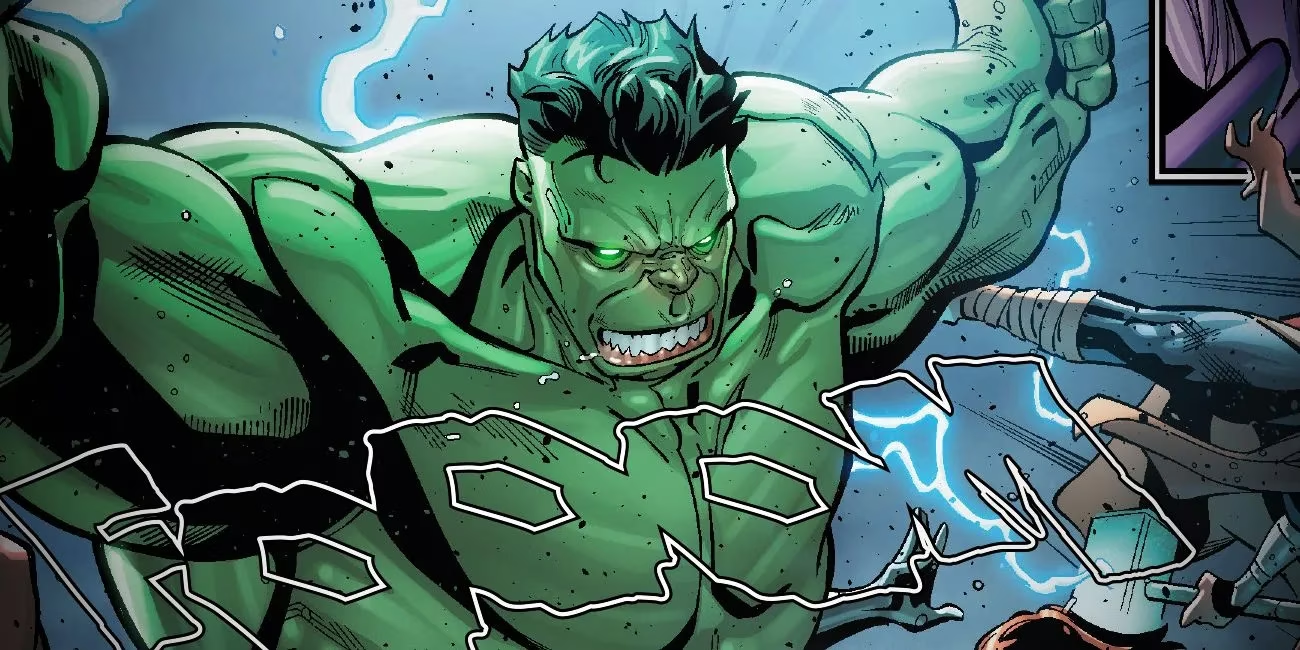
For years, I thought of Kitty Pryde as one of Marvel's most elegant tactical heroes. She walks through walls, disrupts electronics, and turns impossible obstacles into mist. Her power is usually about avoidance, not collision. But the Ultimate Universe revealed the flip side. Instead of selectively phasing through materials, she can stand her ground and become so dense that almost nothing—including brute force—can move her. Density is mass per unit volume, a measure of how compact something is. Pack enough mass into a small space, and the physics get scary. Her super-dense fists hit with the force of Hulk's blows. That sentence should be illegal in a polite power-ranking conversation.
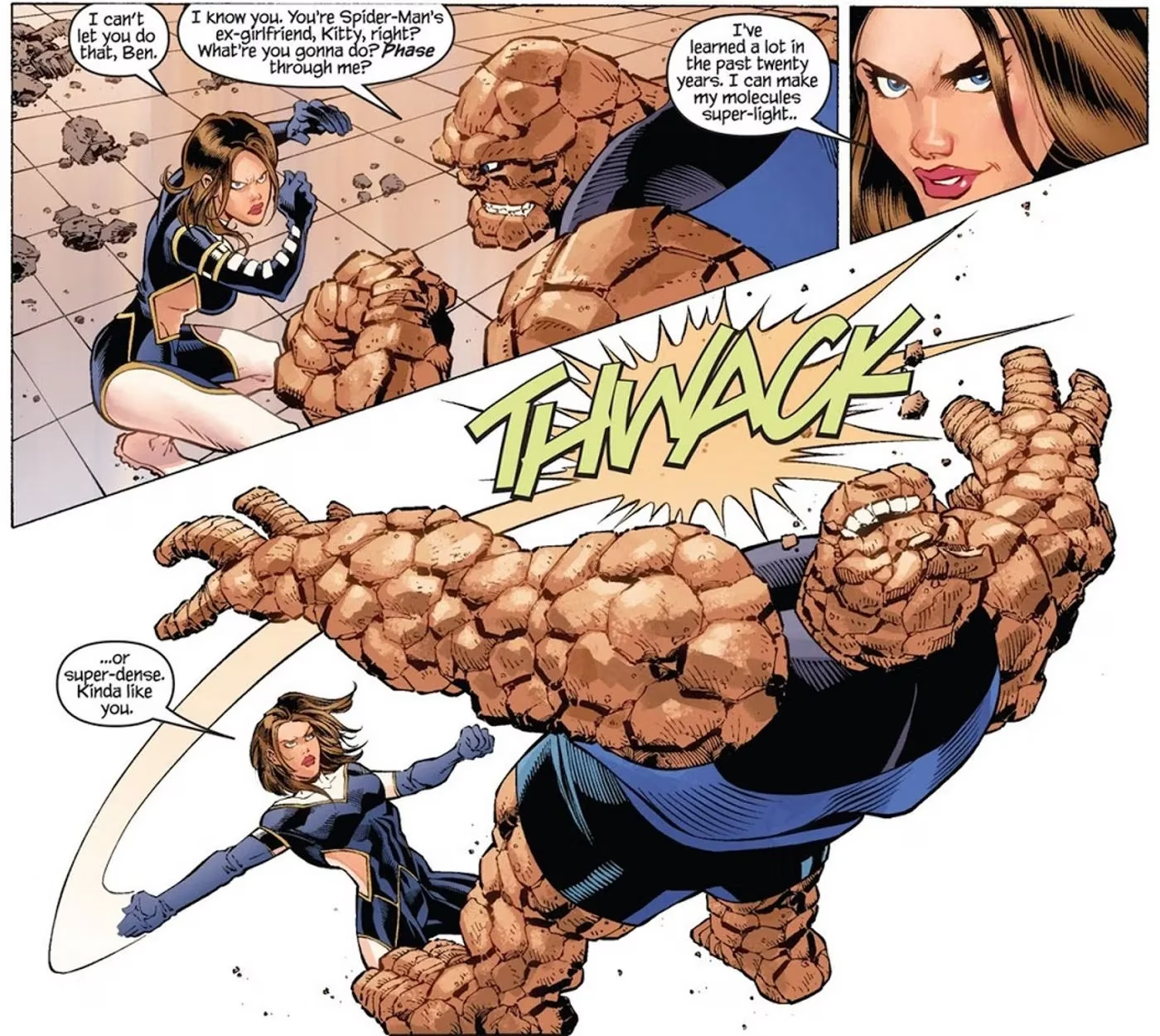
The proof arrives in Ultimate X-Men/Ultimate Fantastic Four Annual, written by Aron E. Coleite and Joe Pokaski with art by Dan Panosian. A Kitty Pryde from twenty years in the future out-clobbers the Ultimate Thing. She delivers a punch that knocks his rocks off—literally. The context is wonderfully messy: Pryde is part of a time-traveling X-Men unit that kidnaps the present-day Mister Fantastic, because he is key to a future version of Sue Storm's mission to eradicate all mutants. The Ultimate Thing's most powerful final form was underneath his rocky exterior all along, so sending him flying with a single blow is not a party trick. It is a declaration.
Then the comparison becomes delicious. This version of the Thing ended the threat of a zombie Hulk with one punch in Ultimate Fantastic Four #23 by Mark Millar and Greg Land. Read that again: the Thing one-punched a Hulk. If that same Thing can be sent flying by Kitty Pryde, then her super-density is a massive power upgrade. It places her among Marvel's heavy hitters, the characters who do not need a team to change a battlefield's geometry. I love that because it turns a hero famous for intangibility into an immovable object and an irresistible force at the same time.
| Character | Key feat | Why it matters |
|---|---|---|
| Hulk | Rivaled by few, an unstoppable force of nature | The gold standard for raw strength |
| Ultimate Thing | One-punched a zombie Hulk in Ultimate Fantastic Four #23 | Proves Thing operates at Hulk-level power |
| Future Kitty Pryde | One-punched Ultimate Thing in Ultimate X-Men/Ultimate Fantastic Four Annual | Suggests her super-density exceeds even that |
In the mainstream 616 universe, Kitty has not exhibited this exact super-dense ability. But it makes sense as a natural balance to the powers she has used for decades. If she can make herself intangible, why not the reverse? If she can phase a building into rubble, why not become a human neutron star? The Ultimate Universe was a creative reimagining that let Marvel explore different paths, and this path gave X-Men fans an unexpected contender. As of 2026, the debate over comics' strongest characters remains alive and loud. Fans still argue about Juggernaut versus Hulk, Hulk versus Superman, and whether raw anger can beat invulnerability. Kitty Pryde adds a stranger question: what happens when the ghost decides to become the anvil?
That is the metaphor I keep returning to. Her intangibility is a ghost slipping through a locked door. Her super-density is the vault door itself, slamming shut in a hurricane. Hulk is a thunderstorm that levels city blocks. Kitty becomes the sea wall that refuses to move—and then punches back with the entire ocean. It is an uncommon image, but so is the idea of a mutant who can match the Jade Giant without gamma radiation, without rage, and without trading her brain for brawn.
Of course, power comparisons in comics are never clean. Writers change rules, retcons arrive like tax audits, and a character's best feat can depend on the decade, the universe, and the artist's mood. Yet the Ultimate Kitty Pryde feat is specific enough to stick. She did not merely survive a hit from the Thing. She knocked him out of the panel. The Thing, in turn, had the credentials to end a zombie Hulk. That chain of evidence makes a compelling case: Kitty Pryde, when written to her full potential, can go toe to toe with the Hulk.
It is a favorite pastime for fans to form strong opinions on who the strongest character in comics is, imagining epic showdowns where Juggernaut proves more powerful than Hulk or where Hulk comes out on top. Writers keep adding new names to the argument, and readers keep sharpening their brackets. Superman, Juggernaut, and Hulk represent tried-and-true standards of strength, but the X-Men now have an unlikely contender. Kitty Pryde can join the ranks of Marvel's most immovable forces.
So when someone asks me who belongs in Marvel's strongest conversation, I no longer stop at the obvious names. I mention Juggernaut. I mention the Thing. I mention Superman, if the crossover gloves are off. Then I smile and say Kitty Pryde. Not the Kitty who phases through sentinels. The Kitty who becomes so dense that the ground apologizes for being in her way. The X-Men have an unlikely powerhouse, and she proves that sometimes the best way to beat an unstoppable force is to become an immovable object—then hit like a collapsing star.