
It’s 2026, and I still remember the electric anticipation as Marvel Rivals hurtled toward its December 2024 launch. With 33 heroes and a promise of eight sprawling maps, Season 0 felt like the start of something monumental. Now, after countless hours of pulse-pounding matches, one map continues to pull me back more than any other: the Intergalactic Empire of Wakanda. This isn’t just a battleground—it’s a living, breathing testament to what happens when ancestral majesty meets unshackled futuristic ambition.
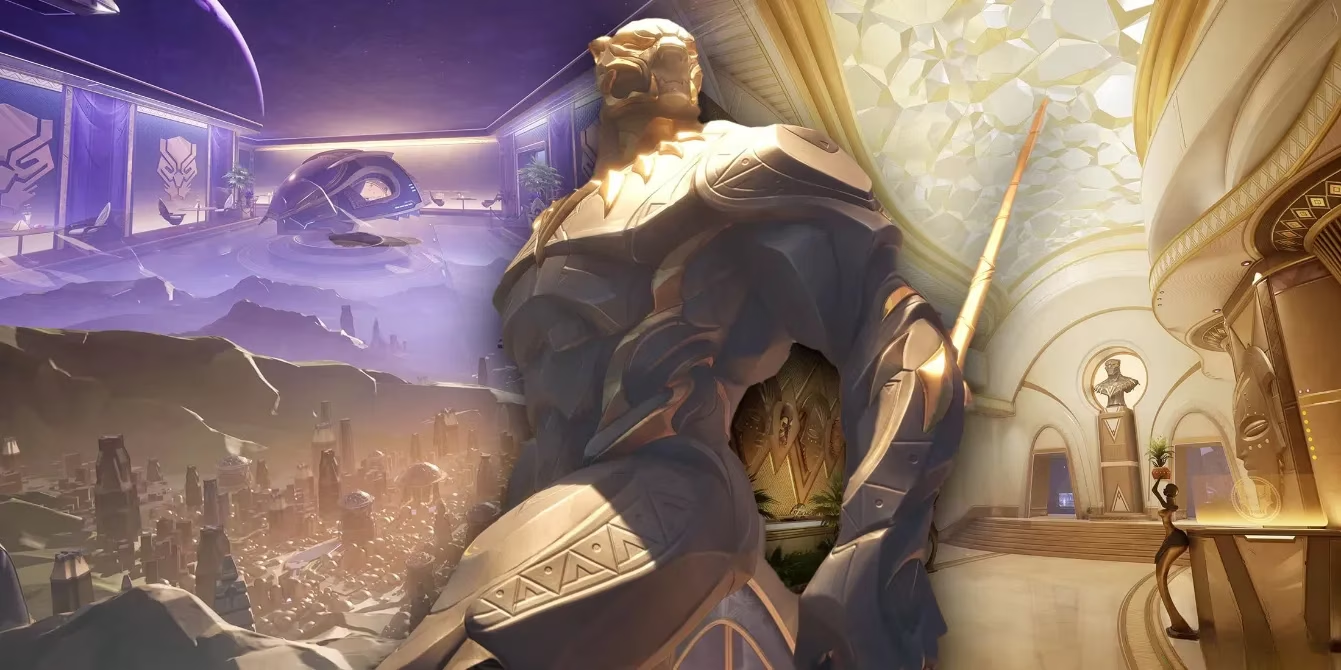
The first time I dropped into Birnin T’Challa, the capital city set on the planet of Bast, I froze for a good ten seconds. Towering statues of the panther god loom over sleek Vibranium spires, and pathways shimmer with an otherworldly glow. NetEase Games didn’t just adapt the comics—they expanded the myth. In the source material, the Intergalactic Empire of Wakanda represents the nation’s reach beyond Earth, and in Marvel Rivals, that cosmic grandeur is fully realized. Every surface feels steeped in history yet crackling with energy, from the carved stone reliefs to holographic interfaces that hum beneath your feet. This is a Domination map, split into three distinct arenas, and winning requires capturing two out of three objectives. The catch? Ultimate charge carries over between rounds, making every engagement a strategic chess match.
Warrior Falls is where I learned to respect the map’s verticality. Water thunders over colossal cliffs, and tight corridors funnel combat into chaotic bursts. I’ve seen Black Panthers and Thors duel atop crumbling pillars while healers scramble to maintain line of sight below. The environment itself is a weapon—walls and ceilings fracture under sustained fire, reshaping cover in real time. I’ve lost track of how many times a well-placed Punisher turret collapsed a ledge, sending an enemy team tumbling into the rapids.
Then there’s the Stellar Spaceport, a gleaming hub of interstellar travel. Here, the battle spills across landing pads and cargo bays, with massive starships drifting in the void just beyond the glass. The open sightlines favor snipers, but smart teams use the moving platforms and destructible containers to close the gap. I vividly remember a match where our Winter Soldier single-handedly held the central hangar because he kept shattering the floor panels every time the enemy tried to regroup. Moments like these make Wakanda feel less like a static arena and more like a narrative engine.
The Imperial Institute of Science is my personal favorite. Shuri’s genius saturates every terminal and reactor. The Vibrani-Chronovium Laboratory, in particular, is a treasure trove of subtle storytelling. You can see prototypes of energy weapons, containment pods with glowing minerals, and even what looks like a chrono-displacement prototype. Although the main fight revolves around the central capture point, I always sneak a moment to wander into the adjacent Duel Field and its preparation room. The developers once teased “secrets players likely won’t expect,” and even two years after launch, the community keeps unearthing surprises. I recently stumbled upon a hidden alcove in Shuri’s Bedroom that projects star charts when a specific sequence of interactions is triggered. It doesn’t affect gameplay, but it threads a deeper sense of discovery into every match.
What sets Wakanda apart for me is how it rewards curiosity without punishing competitiveness. The side rooms like the Duel Preparation Room offer brief sanctuaries where you can reset or plan a flank, yet their destructible walls mean no hiding spot is truly safe. I’ve watched entire sections of the Imperial Institute collapse under a Hulk ultimate, forever altering the flow of battle. This dynamic destruction, combined with the map’s three-objective rotation, ensures no two matches unfold the same way.
From a broader perspective, the Intergalactic Empire of Wakanda represents the golden era of Marvel Rivals’ map design. Back in Season 0, it joined iconic locales like Tokyo 2099’s Shin-Shibuya and Yggsgard’s Royal Palace, but it always felt like the crown jewel. Over the seasons, NetEase has layered in new modes—Convoy on the Wakandan outskirts, Convergence inside the Great Mound—but the original Domination layout remains a fan favorite. Competitive playlists still buzz with teams perfecting their Warrior Falls rotations, and the lore community regularly dissects Bast’s statues for clues about future heroes.
Oddly, what keeps me logging in isn’t the nostalgia; it’s the map’s relentless ability to teach me something new. Last week, I discovered that sticking a proximity mine to a specific constellation mural in the Spaceport triggers a faint, approving roar from Bast herself. It’s a tiny thing, but it’s that kind of detail that transforms a simple hero-shooter map into a world I want to inhabit. The Intergalactic Empire of Wakanda isn’t just a place to fight—it’s a story I keep wanting to explore, one shattered wall at a time.